IGCSE Physics tutor online, for Cambridge 0625 and Edexcel 4PH1.
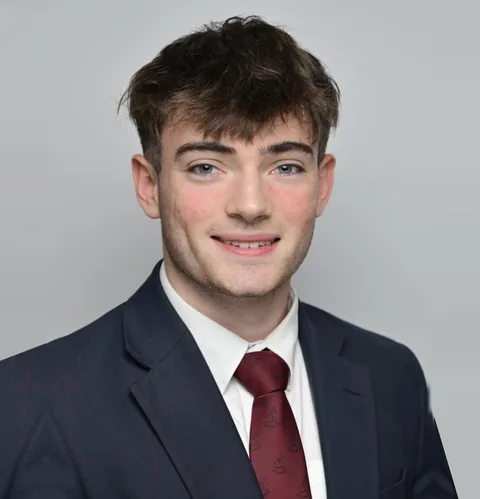
Jake Collins teaches IGCSE Physics online at £40 an hour (5-pack £185), for Cambridge IGCSE Physics (0625) and Pearson Edexcel International GCSE Physics (4PH1), to students at international and British-curriculum schools around the world. He has an A in A-Level Physics and an A* in A-Level Maths, and studies Mathematics and Economics at Newcastle University. Archie Dyer, a Theoretical Physics student at UCL, teaches it at £50 an hour online or £60 in person around Marylebone, London.
The free 30-minute introduction is on Google Meet, one per student, and the tutor confirms each request by email. No card is needed. Prefer Archie? Free introduction with Archie. Prefer to talk first? Call or WhatsApp Archie.
Cambridge 0625 and Edexcel 4PH1And Cambridge 0972, graded 9 to 1. Core or Extended, Paper 5 or Paper 6.
Taught by Jake Collins or Archie DyerJake: A in A-Level Physics, A* in A-Level Maths, Newcastle University. Archie: Theoretical Physics at UCL, 7 in IB HL Physics, 10 A*s at IGCSE.
£40 an hour with Jake5-pack £185. With Archie, £50 online or £60 in person in London. One hour, 1:1.
One tutor for Maths and PhysicsJake teaches IGCSE Maths too, at the same price.
Edexcel 4PH1: 25 May and 18 June 2027November 2026 results: Cambridge 14 January, Edexcel 21 January 2027.
Enhanced DBS checkedBoth tutors, chosen personally by Archie, the founder.
IGCSE Physics tutoring, in short
Who: Jake Collins, one to one on Google Meet at £40 an hour (5-pack £185), or Archie Dyer, the founder, at £50 an hour online or £60 in person around Marylebone, London. Matthew Wright teaches Maths only.
Which courses: Cambridge IGCSE Physics (0625) and Cambridge IGCSE (9–1) Physics (0972), at Core or Extended; Pearson Edexcel International GCSE Physics (4PH1). For a combined or double-award science course, the physics papers are with Archie.
Next exams: Edexcel 4PH1 Paper 1P on Tuesday 25 May 2027 and Paper 2P on Friday 18 June 2027, with results on 19 August 2027. Cambridge 0625 is examined in the June and November series.
After IGCSE: A-Level, International A Level and IB Physics are with Archie.
Both are worth 20%, carry 40 marks and test the same experimental skills (Cambridge’s assessment objective AO3), in the same experimental contexts. In Paper 5, the Practical Test (1 hour 15 minutes), candidates “will be required to do experiments in a laboratory”. Paper 6, the Alternative to Practical (1 hour), is a written paper, and candidates “will not be required to do experiments”. The school enters each student for one of the two.
Either way, the paper is about method and data: measuring quantities, timing motion or oscillations, working with circuits, recording results, plotting graphs with best-fit lines and judging how good an experiment was. Lessons for Paper 6 concentrate on doing all of that on paper, without the apparatus in front of you.
How is Edexcel International GCSE Physics (4PH1) examined?
Two papers, sat by every student: there are no tiers.
Pearson Edexcel International GCSE Physics 4PH1 papers
Paper
Length and marks
Weight
Content
Paper 1P
2 hours, 110 marks
61.1%
The content that is not in bold (no ‘P’ reference).
Paper 2P
1 hour 15 minutes, 70 marks
38.9%
All the content, including the bold ‘P’ statements.
Tiers and grades
Untiered, graded 9 to 1.
Equations
The specification lists relationships that “will not be provided for students either in the form given or in rearranged form”, so they must be learned.
Calculators
A calculator may be used in both papers.
Exam series
November and June.
Double Award
Students on Edexcel International GCSE Science (Double Award) sit the same Paper 1P, as 4SD0/1P. The physics papers of double-award science are with Archie.
R papers. In May and June, schools in 24 countries on Pearson’s list, including China, Hong Kong, India, Japan, Malaysia, Singapore, Thailand and the United Arab Emirates, sit regional R papers (1PR and 2PR) so that more candidates can take exams earlier in the day. They have their own start times and grade boundaries; in 2027 they are on the same days as the main papers. There are no R papers in November.
What marks did you need for each grade in June 2026?
These are Pearson’s June 2026 grade boundaries for Edexcel 4PH1, out of 180: the two papers added together. A boundary is the lowest total that earns the grade.
Pearson Edexcel International GCSE Physics (4PH1) grade boundaries, June 2026, out of 180
Grade
Main papers (1P, 2P)
R papers (1PR, 2PR)
9
138 (77%)
134 (74%)
8
121 (67%)
116 (64%)
7
105 (58%)
99 (55%)
6
94 (52%)
88 (49%)
5
83 (46%)
77 (43%)
4
72 (40%)
67 (37%)
3
60 (33%)
56 (31%)
2
49 (27%)
45 (25%)
1
38 (21%)
35 (19%)
Percentages are rounded. Boundaries move every series, so treat them as a guide to the standard rather than a target for 2027; Pearson publishes the June 2027 boundaries on results day, 19 August 2027. Cambridge publishes its own threshold tables for 0625, set separately for each combination of papers.
When are the 2026–27 IGCSE Physics exams and results?
IGCSE Physics exam and results dates, November 2026 to August 2027
Date
What happens
Wednesday 11 November 2026, morning
Edexcel 4PH1 Paper 1P, 2 hours (November series).
Wednesday 18 November 2026, morning
Edexcel 4PH1 Paper 2P, 1 hour 15 minutes (November series).
Thursday 14 January 2027
Cambridge IGCSE results for the November 2026 series.
Thursday 21 January 2027
Edexcel International GCSE results for November 2026.
21 March 2027
Pearson’s June 2027 entry deadline for international centres. Schools make the entries.
Tuesday 25 May 2027, morning
Edexcel 4PH1 Paper 1P, 2 hours. R paper 1PR on the same day.
Friday 18 June 2027, morning
Edexcel 4PH1 Paper 2P, 1 hour 15 minutes. R paper 2PR on the same day.
Thursday 19 August 2027
Edexcel International GCSE results and grade boundaries for June 2027.
In June 2027 the two Edexcel papers are more than three weeks apart. Cambridge 0625 is sat in the June and November series; the school’s exams officer has the June 2027 dates for your school. For every board’s dates in one place, see the international exam and results dates guide.
Where do students commonly lose marks in IGCSE Physics?
These are observations about how the papers are built, not statistics about any group of students.
Equations that must be recalled. Neither board hands students the core relationships, so knowing them is the first step and rearranging them is the second.
Units and prefixes. A correct method still gives a wrong answer if kilowatts, milliamps or minutes are not converted first.
The practical paper. Cambridge’s Paper 5 or 6 is a fifth of the grade, and it rewards method, readings, tables and graphs rather than recall.
Multiple choice against the clock. Cambridge’s 40 questions in 45 minutes is just over a minute each.
The bold content on Edexcel Paper 2P. Paper 2P can test the bold ‘P’ statements, which Paper 1P does not.
Extended written answers. Pearson lists extended open-response questions among its question styles. Explaining in full sentences is a different skill from calculating.
Who teaches IGCSE Physics at Cognivia Tutoring?
Two tutors teach IGCSE Physics: Jake Collins and Archie Dyer, who founded Cognivia Tutoring and still teaches. Matthew Wright teaches Maths only. Each tutor was chosen personally by Archie, and a family keeps the same tutor every week.
Jake Collins
A in A-Level Physics and A* in A-Level Maths (2025), in the sixth form at Haileybury, Hertfordshire.
Second-year Mathematics and Economics student at Newcastle University, with a 2:1 in his first year.
10 GCSEs, including Maths and Physics: two 9s, two 8s, three 7s and three 6s.
Tutoring for over two years, with more than 10 students. Enhanced DBS checked.
Online only, on Google Meet, at £40 an hour for IGCSE (5-pack £185).
Jake teaches Physics at GCSE and IGCSE only: A-Level, International A Level and IB Physics are with Archie. He also teaches IGCSE Maths, so a student taking both can keep one tutor. He is new to Cognivia Tutoring and has no reviews here yet; more on Jake’s profile.
Archie Dyer
Physics is what Archie studies: he is a second-year Theoretical Physics student at UCL, after a First in his first year.
43 out of 45 in the IB, with 7s in HL Maths, Physics and Economics.
10 A*s at IGCSE.
Tutoring for over two years, in Maths, Physics, Chemistry and Economics. Enhanced DBS checked.
£50 an hour online, or £60 in person around Marylebone, London.
Archie also teaches IGCSE Chemistry at the same price, and A-Level Physics, including Cambridge International AS & A Level Physics (9702) and Pearson Edexcel International A Level Physics, and IB Physics, so lessons can carry on into the sixth form. Online Physics tutoring sets out every level, tutor and price in one place.
How he teaches. In Archie’s words: “I find where the understanding actually breaks down, which is usually two or three topics further back than where the marks were lost, and we rebuild from there. I keep lessons relaxed. I would far rather a student asked me something they think is obvious than sat quietly and nodded.” There is more on the About Archie page.
How much do IGCSE Physics lessons cost?
IGCSE Physics prices at Cognivia Tutoring, by tutor
Tutor
1-hour lesson online
5-pack online
In person
Jake Collins
£40
£185
Online only
Archie Dyer
£50
£235
£60 (5-pack £285)
30-minute introduction, either tutor
Free
—
Online only
Each tutor charges the same for Cambridge and Edexcel. With Archie, IGCSE Physics and Chemistry are the same price, and in-person lessons around Marylebone, London, are with him only. A 5-pack is held in a My lessons account and booked one lesson at a time.
1 hour, 1:1. The same tutor every week. There are no group classes.
Online on Google Meet. The Meet link is in your confirmation email, and times are shown in your own time zone.
Free 30-minute online introduction, no card needed. About 10 minutes on goals, 15 working through one question together and 5 on a plan. One per student; the tutor you choose confirms the request by email, usually within a day.
24 hours’ notice to cancel, by email or phone. See the refund policy.
Payment in pounds by Stripe at booking. Card, Apple Pay or Google Pay.
Each tutor’s booking calendar shows their open times in your own time zone. Lessons are usually on weekday late afternoons and evenings and during the day at weekends, UK time. While the UK is on GMT (late October to late March), UK times convert like this:
Local times for three UK lesson times while the UK is on GMT
UK time
Doha
Dubai
Singapore and Hong Kong
Tokyo
10:00
13:00
14:00
18:00
19:00
14:00
17:00
18:00
22:00
23:00
17:00
20:00
21:00
01:00, next day
02:00, next day
For families in East Asia, UK weekend daytime is usually the practical window. From late March, when the UK moves to British Summer Time, each local time is an hour earlier. The page on online tutoring from abroad has the full tables, including Milan, Geneva and New York.
FAQ
IGCSE Physics questions, answered
At Cognivia Tutoring, IGCSE Physics lessons with Jake Collins are £40 an hour online, or £185 for an online 5-pack of five 1-hour lessons. With Archie Dyer, the founder, they are £50 an hour online or £60 an hour in person around Marylebone, London; his 5-packs are £235 online and £285 in person. There is no registration fee, and the first 30-minute introduction is free. All prices are on one page.
Yes. Jake teaches IGCSE Physics, including Cambridge IGCSE Physics (0625) and Pearson Edexcel International GCSE Physics (4PH1), online at £40 an hour. He has an A in A-Level Physics and an A* in A-Level Maths, and studies Mathematics and Economics at Newcastle University. He also teaches IGCSE Maths, so a student taking both can keep one tutor.
Not for the core relationships. The Edexcel 4PH1 specification lists the relationships that “will not be provided for students either in the form given or in rearranged form”, so they have to be learned. The Cambridge 0625 syllabus marks many relationships “recall and use the equation”, so students should expect to know them too.
Both are worth 20% of the grade, carry 40 marks and test the same experimental skills. Paper 5, the Practical Test, lasts 1 hour 15 minutes, and candidates do experiments in a laboratory. Paper 6, the Alternative to Practical, lasts 1 hour and is a written paper with no experiments. The school enters each student for one of the two.
No. Pearson Edexcel International GCSE Physics (4PH1) is untiered: every student sits Paper 1P (2 hours, 110 marks, 61.1%) and Paper 2P (1 hour 15 minutes, 70 marks, 38.9%), graded 9 to 1. Cambridge IGCSE Physics (0625) is tiered, with Core (grades C to G) and Extended (grades A* to G).
138 out of 180 on the main papers (1P and 2P), about 77%, and 134 out of 180 on the R papers (1PR and 2PR), about 74%. A grade 7 needed 105 (main) or 99 (R), and a grade 4 needed 72 or 67. Boundaries change every series, so treat them as a guide to the standard, not a target.
For Pearson Edexcel 4PH1, Paper 1P is on the morning of Tuesday 25 May 2027 (2 hours) and Paper 2P on the morning of Friday 18 June 2027 (1 hour 15 minutes); the R papers are on the same days. Results are on Thursday 19 August 2027. Cambridge IGCSE Physics (0625) is examined in the June and November series; the school’s exams officer has the June 2027 dates for your school.
Cambridge IGCSE results for the November 2026 series are released on Thursday 14 January 2027, and Pearson Edexcel International GCSE results on Thursday 21 January 2027. The Edexcel 4PH1 November papers are timetabled for 11 and 18 November 2026.
No. Jake teaches Physics at GCSE and IGCSE only. A-Level Physics, International A Level Physics (including Cambridge 9702 and Pearson Edexcel IAL) and IB Physics at Standard and Higher Level are with Archie Dyer, at £55 an hour online or £65 in person.
Yes. Lessons are online on Google Meet, in English, for students anywhere, and the booking calendar shows each tutor’s open times in your own time zone. While the UK is on GMT, a 17:00 UK lesson is 20:00 in Doha, 21:00 in Dubai and 01:00 the next day in Singapore and Hong Kong, so families in East Asia usually look at UK weekend daytime slots. Prices are in pounds sterling, paid by card, Apple Pay or Google Pay through Stripe.
Yes, with Archie Dyer only, at the same price as his Physics lessons: £50 an hour online or £60 in person around Marylebone, London. Biology is not offered. For a combined science course, Archie can cover the physics and chemistry papers, but the biology papers would need a different tutor. See GCSE and IGCSE Chemistry tutoring.
Book the free 30-minute introduction with the tutor you are considering. It is about 10 minutes on goals, 15 minutes working through one question together so you can see how the tutor explains things, and 5 minutes on a plan. It costs nothing and needs no card. There is one per student, and a parent or guardian joins if the student is under 18. Choose a time at least 6 hours ahead; the tutor reads each request and confirms it by email.
Where to go next
The free 30-minute online introduction is the simplest first step. Nothing is charged and no card is needed.
Tell the tutor the board, the papers and the exam series, work through one question together and leave with a plan. Online, free, one per student, and no card needed.